Wednesday, 12 October 2011

Comparing PCR

PCR vs Vector cloning
VS

Similarity – Both uses gel electrophoresis to locate the desired gene.  
They both are used to create huge quantities of DNA.
Difference –Vector cloning uses plasmid, bacteria, ands REs. PCR uses Taq polymerase, dNTP, ddNTP.
Vector cloning involves multiple steps and is not as quick as PCR.
PCR creates lot of DNA sequence, while Vector cloning creates modified bacteria containing the genes to create the desired proteins.
PCR  vs DNA sequence
VS
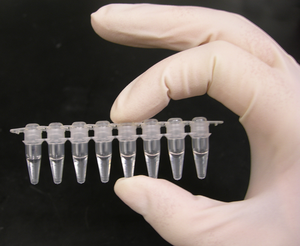
Similarity – both uses gel electrophoresis to identify the fragments.
Both uses dNTP to create large quantity of DNA sequence.
Both uses heating and cooling.
Difference – PCR tries to create a lot of the target sequence. DNA sequence tries to determine the sequence of ATGC.
DNA sequence uses small amount of ddNTP to create DNA fragment of different length, While PCR only uses dNTP to create complete fragment.

Sunday, 2 October 2011

10 things to remember


1. Frederick Griffith discovers DNA contains the genetic information through his experiment with the phenomenon he dubbed as ‘Transformation’.

2. Watson and crick discovered the DNA structure – the double helix- with the help of Rosalind’s x-ray of DNA.


3. Nucleotide are made of phosphate (negatively charged), Sugar (DNA lack one oxygen), and Nitrogenous base. Nucleoside doesn’t have phosphate.

4. A%=T%, G%=C%. A and G are purines. T and C are pyrimidine.

5. All new strand of RNA or DNA are made from 5’ --> 3’.


6. Transcription beings from the 5’ TATA 3’ box and ends with the AAUAA sequence on the RNA.

7. RNA mod #1: 5’ G cap + 3’ poly a tail protects the mRNA.


8. RNA mod #2: RNA splicing cuts out the intron with spliceosome to make sure there’s no mutation.


9. Translation beings with 5’ AUG 3’, reads codons and ends with UAA, UAG, UGA.


10. Enzymes are very important.
-Polymerase I: Proof reads the new DNA strand and replaces RNA with DNA nucleotide. (DNA replication)
-Polymerase II: Binds to TFs, untwist the double helix, reads the template strand and grabs RNA nucleotides to form pre mRNA. (Transcription)
-Polymerase III: elongate the new DNA strand by grabbing DNA nucleotides. (DNA replication)
-Primase: Makes primer to initiate elongation. (DNA replication)
-Ligase: joins gaps between Okazaki fragments. (DNA replication)
-TFs: binds to the promoter region at the initiation. (Transcription)
-Helicase: untwist DNA and splits DNA into single strand. (DNA replication)
-SSBP: stabilise single strand DNA. (DNA replication)
-Gyrase: release tension made by Helicase by splitting the DNA. (DNA replication)
-Spliceosone: cuts the introns out of the mRNA. (Transcription)

Reflection: Deaf by design

Deaf by design is a very interesting article about deaf parents and their quest for a deaf baby. The deaf community being closely knit keeps them quite isolated from the outside world. They often reply on one another for support. And out of fear of not knowing how to raise their child to be a ‘hearing’, or having a negative opinion of the ‘hearing’ society. Those thoughts would lead them to make the decision of having a deaf child. Some deaf parents would even abort a healthy baby just to have a deaf one.
Through this study, it addresses the issue of should we be selecting for traits. My subjective view on this topic is quite hypocritical because I believe that it is okay to allow people to select for traits as long as the trait being selected is socially considered ‘good’. For example, I believe it is okay to abort baby with deaf hearing but you cannot abort baby if they are perfectly healthy. The reason for this is because I believe being deaf is a disability. Being deaf removes one’s ability to hear clearly and being able to hear doesn’t prevent one from learning things deaf people learn.  Also, I believe sign language is just another language that becomes an advantage for one to have just as any other language. Objectively I understand that we have to be fair. So if someone can abort because of a ‘bad’ trait we should be able to abort because of a ‘good’ trait especially when ‘bad’ and ‘good’ are such loose words.
Another problem that arises from this is what is considered good and what is considered bad. Suppose we decide to put regulation on this issue. Drawing the line between what is acceptable for abortion and what isn’t is quite difficult. I cannot say where the line should be draw because of my limited knowledge in the field; however I do believe that there should be a line.
My final opinion on this topic is that we should have minimum regulation on this issue. The regulation should be enough to prevent everyone from selecting for traits. This should be done to prevent the lost of genetic variation amongst the population. Genetic variation is very important to the survival of our species.